
Geopolitics Daily Brief — June 8, 2026
Five stories at 08:00 UTC: Iran and Israel trade direct missile strikes on Day 100 of the Iran war as Houthis threaten Red Sea shipping; Russia attacks Chernobyl's spent nuclear fuel store while Zelenskyy and E3 leaders set five peace conditions in London; China sends coast guard ships into Taiwan's eastern restricted waters with the Liaoning carrier east of the Philippines; Xi Jinping lands in Pyongyang for his first North Korea visit in seven years; Brent rises 4.6% to $97, Kospi falls 8.3%, and semiconductor stocks from Samsung to TSMC lead a broad Asia selloff.

Five stories at 08:00 UTC — Iran-Israel escalation, Russia strikes Chernobyl fuel store, China coast guard enters Taiwan's eastern waters, Xi in Pyongyang, and a broad market selloff.
1. Iran and Israel trade direct strikes; Houthis threaten Red Sea shipping
On Day 100 of the Iran war, Israel and Iran exchanged direct missile attacks for the first time since the April 8 ceasefire, threatening to pull the wider Middle East back into full-scale conflict.1
The exchange began when Israel struck Hezbollah positions in southern Beirut — against explicit US requests for restraint — prompting Iran's IRGC to launch ballistic missiles against two Israeli military bases in what it called "Operation Nasr (Victory)." Israel retaliated before dawn Monday, hitting radar stations in three Iranian provinces plus a petrochemical plant in Mahshahr, Khuzestan. The IRGC confirmed the Israeli strikes hit Isfahan, Karaj, Tabriz, and the outskirts of Tehran, where Iran closed Imam Khomeini International Airport's surrounding airspace. Jordan activated nationwide air raid sirens. Saudi Arabia briefly sounded an alarm near Prince Sultan Air Base, which hosts US forces, before declaring it a false alert; Iran denied any role.1
Trump told reporters he had called Netanyahu to urge against an immediate counter-strike and said "all orders come from me — Netanyahu has no choice."1 The White House declined to say whether Israel coordinated the dawn strikes. Pakistan's interior minister was in Tehran brokering a renewed nuclear deal when the Beirut attack occurred; mediators from Egypt, Saudi Arabia, Turkey, Pakistan, and Qatar have urged both sides to stand down.
Yemen's Houthis separately declared they would target Israel-affiliated vessels in the Red Sea, the Gulf of Aden, and the Bab el-Mandeb, reprising the campaign that sank four ships and killed nine seafarers during the earlier Gaza conflict and forced rerouting of roughly $1 trillion in annual Red Sea cargo.

Market/supply-chain impact: Brent crude jumped 4.6% to above $97/barrel on the Monday session, reversing last week's pullback and raising inflation expectations.2 Houthi re-entry into the Red Sea shipping lane adds a second layer of freight-cost pressure to global supply chains. Iran's Hormuz leverage — still operational — means any full resumption of hostilities could cut roughly 20–25% of seaborne oil supply. Saudi Arabia's own oil export route via the East-West pipeline (Yanbu) reaches the Red Sea, directly in the projected Houthi threat zone. US 10-year Treasury yields rose 4 basis points to 4.57%, with markets now pricing two Fed rate increases over the next 12 months.2
2. Russia strikes Chernobyl nuclear fuel store; E3 and Zelenskyy set five-point peace conditions
In a night attack on June 7, a Russian Geran-2 drone struck the Centralized Spent Nuclear Fuel Storage Facility in the Chornobyl Exclusion Zone, damaging the fuel reception building and the IAEA administrative office. No nuclear fuel was present in the affected structure, no casualties occurred, and radiation levels remained normal; a 40-square-metre fire was extinguished.3 Ukraine's state nuclear operator Energoatom called it "nuclear terrorism," the Security Service of Ukraine classified it as a war crime, and the Prosecutor General's office opened a criminal investigation.3 Russia's drone also hit a train travelling from Moscow to Simferopol, killing one person.4
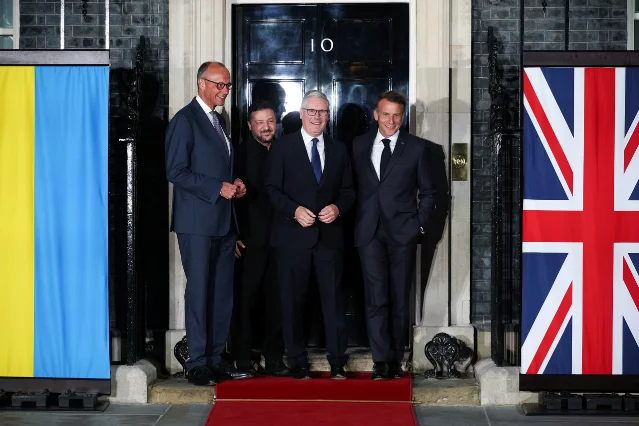
Separately, Zelenskyy met UK Prime Minister Starmer, French President Macron, and German Chancellor Merz at 10 Downing Street on Sunday. The four leaders issued a joint E3+Ukraine statement setting five conditions for a just and lasting peace: an immediate, complete ceasefire; the current line of contact as the starting point for negotiations (no territorial changes by force); legally binding security guarantees including deployment of the Multinational Force — Ukraine; Russian assets to remain frozen until Russia compensates Ukraine for war damages; and European security interests safeguarded in any deal.5 Zelenskyy also said he is prepared to freeze front lines at current positions to end the war — the clearest offer yet of a ceasefire in place.4 Putin publicly rejected the proposal, calling it insincere and demanding preconditions. Korean Herald reported European leaders confirmed readiness to support direct Zelenskyy-Putin talks.6
Market/supply-chain impact: The Chornobyl strike pushes nuclear safety back onto European energy policy agendas. The Zelenskyy ceasefire signal is the most direct diplomatic move in months and, if matched by Moscow, would ease European defence spending and natural gas supply pressure — but Putin's flat rejection indicates the war economy overhang on European energy and industrial inputs continues. Defence procurement contracts across Europe remain on long lead times.
3. China sends coast guard ships into Taiwan's eastern restricted waters; Liaoning tracks east of Philippines
Taiwan's Defence Minister Wellington Koo confirmed on June 8 that four Chinese coast guard vessels entered Taiwan's restricted eastern waters before being warned off by Taiwan's Coast Guard, which dispatched vessels and caused the Chinese ships to depart eastward in the early morning hours.4 Koo described the incursion as a "provocative act" and "cognitive warfare — they are attempting to claim the eastern waters as their domain." Chinese state media published footage of a Chinese officer telling Taiwan's Coast Guard: "the two sides of the Taiwan Strait are both part of one China."
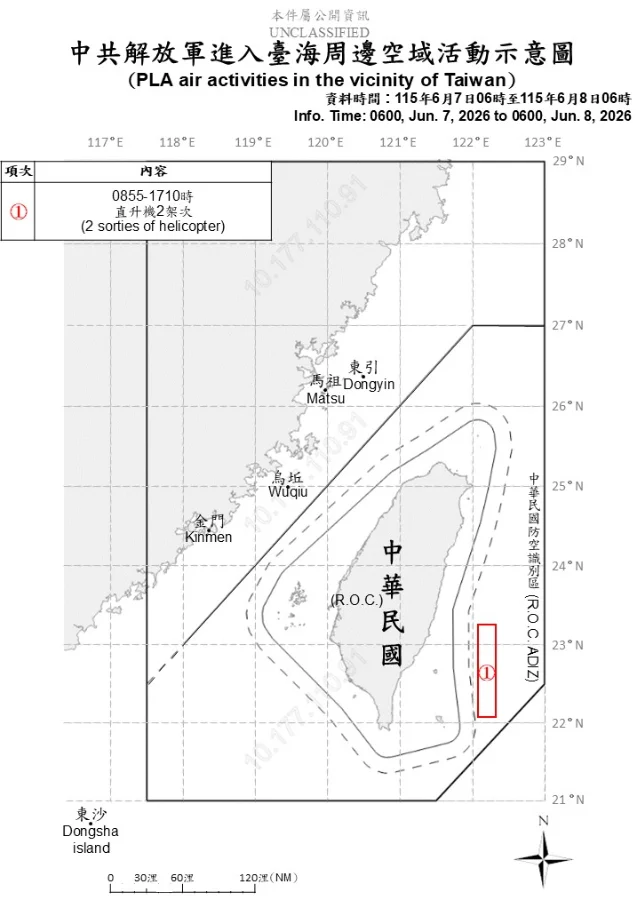
In a separate daily tracking report, Taiwan's Ministry of National Defense recorded 13 Chinese ships (7 official vessels, 6 naval) and 2 PLA military helicopters operating around Taiwan between June 7–8, with the helicopters entering Taiwan's eastern ADIZ. Taiwan deployed aircraft, naval ships, and coastal missile systems in response.7 So far in June, Taiwan has logged 92 PLA aircraft contacts and 97 ship contacts. Koo added that the Chinese aircraft carrier Liaoning is currently operating east of the Philippines.
The immediate trigger for the coast guard incursion appears to be Japan and the Philippines announcing formal talks on maritime boundary delimitation — a development Beijing denounced.4
Market/supply-chain impact: The Liaoning's deployment east of the Philippines keeps the western Pacific chokepoint — including key semiconductor supply routes between Taiwan and Japan — under PLA surveillance. The eastern water incursions extend China's gray-zone pressure from the Strait to Taiwan's Pacific flank, a new operational pattern. Continued harassment disrupts the planning horizon for chipmakers and logistics operators routing cargo through the western Pacific.
4. Xi Jinping arrives in Pyongyang for first North Korea visit in seven years
Chinese President Xi Jinping landed in Pyongyang on Monday for a two-day state visit with Kim Jong Un — his first trip to North Korea since 2019 and, according to Reuters, his first overseas visit of 2026.8 Kim greeted Xi with a full gun salute and honour guard. In remarks published by North Korean state media before his arrival, Xi said China-DPRK ties are at a "new historical starting point" and pledged to work with Pyongyang to "fight hegemony" — language widely read as aimed at the US.8 The visit comes days after North Korean state media showed Kim inspecting a new nuclear fuel production facility (June 3) and sea-trialling the destroyer Kang Kon (June 4), signalling a deliberate pre-summit military messaging sequence by Pyongyang.
Separately, a Reuters poll published June 8 found China's May exports likely surged, driven by front-loaded orders from buyers pre-empting energy price pressures tied to the Gulf war and sustained global semiconductor demand.9 The pre-loading dynamic — importers pulling orders forward to beat cost increases — mirrors the pattern seen before previous tariff deadlines.
Market/supply-chain impact: Xi's choice of Pyongyang as his first overseas trip of 2026 signals China is shoring up its northeast Asian strategic perimeter at a moment when US attention is split across the Iran war, Ukraine, and the July 24 forced-labour tariff deadline. For procurement managers, the combination of a stronger China-DPRK axis and continued chip demand makes further semiconductor supply diversification away from northeast Asia a higher-priority planning item. The front-loaded export surge will flatter China's May trade data but signals weaker underlying demand momentum into Q3.
5. Markets: Brent at $97, Kospi -8%, chip stocks hit across Asia as Iran risk reprices
Monday's Iran-Israel exchange triggered the sharpest single-session repricing across Asian and European markets since the April 2025 tech selloff.2 Brent crude rose 4.6% to above $97/barrel, its highest since early May. MSCI's Asian equity gauge fell 3.2%; South Korea's Kospi dropped 8.3%, its steepest decline since the 2025 Nasdaq shock. Samsung Electronics fell as much as 11%, SK Hynix 10%, and TSMC 5.7%. In Europe, ASML and ASM International each fell more than 2%. S&P 500 and Nasdaq 100 futures steadied, up 0.3% and 0.6% respectively, suggesting the selloff remained concentrated in Asia and semiconductor names rather than spreading to a broad US equity decline.2
The confluence of factors: oil above $97, two Fed rate hikes now priced over the next 12 months (10-year Treasury yield at 4.57%), and a pullback in AI equity valuations after a prolonged run. Bitcoin rose 2.1% to above $63,000, recovering from a dip below $60,000 on Friday — its first breach of that level since Trump's 2024 election victory.2
Goldman Sachs Asia Pacific chief equity strategist Tim Moe characterised the move as a technical correction within a long-term bull market. Bloomberg macro strategist Skylar Montgomery Koning said both core drivers — AI and energy — had turned negative simultaneously, and advised against adding risk exposure in the near term given dense event risk over the coming two weeks.2
Strait of Hormuz transit fees have risen to as much as $2 million per vessel.10 That tariff, on top of rerouting costs if the Red Sea becomes operationally closed again, materially raises the landed cost of any commodity or manufactured good flowing through the Gulf.
References
- 1Israel and Iran trade strikes, threatening to drag region back to full-scale war
- 2Stocks, Bonds Fall as Mideast Strikes Lift Oil: Markets Wrap
- 3Russian forces strike Centralized Spent Nuclear Fuel Storage Facility in Kyiv region
- 4Chinese ships leave Taiwan's restricted waters after warning — Caliber.Az news feed
- 5Leaders of Ukraine, the UK, France and Germany outline five conditions for lasting peace
- 6European leaders ready to support ceasefire talks between Ukraine, Russia
- 7Taiwan tracks 13 Chinese ships, 2 military helicopters
- 8Flags, gun salute greet China's Xi on arrival in North Korea for summit
- 9China exports set for strong May on front-loaded orders, chip demand
- 10Caliber.Az — Transit fees through Strait of Hormuz
Add more perspectives or context around this Post.